Showing posts with label nature. Show all posts

Monday, March 17, 2014

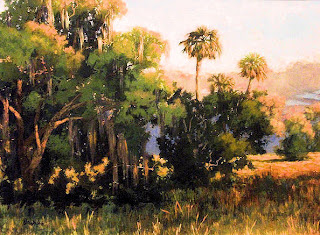
A new Tree Painting


Trees
16x20 inches
Oil on canvas
www.lindablondheim.com

Notes From My Tree Painting Journal

This is the first painting I did at my new studio space. I enjoyed it. I used the same palette that I practiced with in the pine forest at Wekiva State Park. I am finding that I really like the simplicity of the  greens mixed with the palette. 

I'll soon be painting the brilliant colors of Spring. 

Thursday, January 23, 2014

Amazing Nature


Ice Trees

Notes From My Tree Painting Journal

I took this photo this morning before I started my truck, Leroy. It is an amazing tree painting by nature in ice. What a lovely gift to me. Nature knows I am a tree painter. 

This week I am working on an 18x24 oil painting of trees. I am having a hard time with the painting, trying to work out issues with the trunks. Some foreshortening and textural issues to overcome. If trees were easy to paint, everyone would paint them!

I keep plugging along, learning what I can about painting them. I need to get started on another champion tree. I am doing a small commission too, so my champion trees are waiting patiently in the wings. 

Friday, November 25, 2011

Tuscawilla Prairie Trees


Notes From my Tree Journal

I've been doing a few small paintings of trees at Tuscawilla Prairie. Last week when  I was there, I was able to get quite a few reference photos after I did my first painting. This week while people are out shopping, I'm in the loft studio for extended hours and so I'm taking advantage of the extra studio time to study those photos of trees at the prairie.

This is a limited palette of:

Trans Red Iron Oxide
Ultramarine Blue
Ivory Black
Titanium White
Cadmium Yellow Medium
Cadmium Yellow Lemon
Yellow ochre
Cadmium Red Light

Expanded from the palette I have been using a lot lately by adding the cad medium yellow and trans red iron oxide.


Sunday, November 20, 2011

A Quick Demonstration


Notes From My Tree Painting Journal

It's my view that a teaching demonstration should focus on a variety of techniques and ideas rather than on doing a refined lovely painting just to look good and impress your students. Painting Demos for patrons is another matter. You want to wow them with your expertise. The above 9x12  was a teaching demo today for a few students. It wound its way through many different brush work techniques, paint mixing advice, and glazing techniques. I did not focus on a sophisticated composition at all. I wanted the composition to be easy to follow, so I did a simplified version of another more complex painting done earlier. I use a five value family when I teach and for my own work. Light-half tint light-mid-half tone dark and dark. I teach using a variety of textures, a variety of color temperatures and values, gradually mixing variations for interest. I use palette knife, brushes, opaque and glazing with mediums. All good fun.

Thursday, September 29, 2011

Tree Trunks


Why Do People Paint Tree Trunks?

A reader asked this question. Here is what my research revealed: From E-How.com

If you have ever noticed a beautiful tree with a painted white trunk and wondered why someone would go through the trouble; there may be a good reason. The white painted bottom is rarely a decorative statement or an attempt to make the tree more aesthetically pleasing. It is, however, a practice that can potentially save the life of the tree. Trees can benefit from a coating of white paint when recent landscaping has entailed the removal of a larger tree that once provided shade for another, or the excessive removal of branches has left a tree barren and its trunk exposed to the sun's rays

Sunscald
  1. The bark of trees is just as susceptible to sun damage as is human skin. Too much hot sun directed onto a tree trunk day after day may not leave behind a sun burn but it will cause damage to the bark that will become noticeable over time. Arborist Mario Vaden explains that sunscald is denoted by bark that cracks and falls off, or simply changes color. Wrapping the tree with a specially designed trunk cover or painting the tree trunk can prevent sun damage.

    Bores

  2. A tree borer is an insect that tunnels underneath the bark of a tree and cause severe damage to the underlying layers of the tree. Adult tree boring insects will even lay eggs under the bark; leaving larva to chomp away at the phloem (nutrient-transporting layer) of the tree. According to the University of California, a large infestation of tree borers feeding on a single tree can result in damage that can only be rectified by heavy pruning or removal of the tree. Tree boring insects often seek out trees with the weakest outer protection, so painting trees that are susceptible to sunscald can prevent bark damage and keep tree borers at bay.

    Splitting

  3. According to the University of Missouri Extension, white latex paint can also be used to prevent the bark of a tree from splitting and cracking off. This can happen when the tree is exposed to freezing evening temperatures followed by a daytime thawing. The painted white trunk will help reflect sunlight during the daytime hours and keep the tree warmer at night.

    Animal Damage

  4. Painting the trunks of trees is also helpful in deterring furry, four-legged vermin. There are some wild animals that feast on tree bark, causing severe damage to the trees that become their daily lunch. According to the University of Vermont, adding a small amount of rabbit repellent to the white paint can prevent hungry rabbits from gnawing on tree bark.

    Misconceptions

  5. Contrary to popular belief, you do not need to use white paint to protect a tree trunk. In fact, Ed Laivo from the Dave Wilson Nursery reveals that any light-color paint can be used. What is important, though, is the type of paint used. Latex based paint that is used to paint the interior of your home is sufficient, but if you want to be "green" use paint that has an organic base. Never use an exterior paint because it contains fungicides that can harm the tree.


Saturday, September 10, 2011

Sky Holes


Sky Holes are an important part of painting trees. Tree Canopies need an airy three dimensional look to be realistic. This is the way I paint them.


 Many beginners try to put the sky into the painting and then struggle to put trees and objects over it.  I like to do the opposite. I like to plug in the objects roughly and then plug in the rough sky through and around them. I never work one part of the painting more than any other.  I might go back into the sky two or three times during the painting process, correcting and adding here and there, as the tree masses develop. At the end, I will go in and do sky holes and adjust the existing edges between trees and sky.

Sky holes should not be too many or too few and they should not be too ordered. Random placement, unevenly spaced, more at the top of the tree line and a variety of shapes is best.

Your sky holes will be more realistic if you change the value slightly darker than the rest of the sky.  I tend to darken more with small sky holes that are further down into the tree mass and less as the sky holes are near the top of the tree mass. Also, larger sky holes will have slightly lighter value than small ones. This is because more light is going through the trees in larger holes. Keep in mind that the more depth and atmospheric condition, the softer the sky hole will be.

The last thing I do is to take a large flat dry brush and softly touch the brush to the sky holes, one at a time, just straight onto the canvas and lifting straight off.  This will soften the edgework just a tiny bit but will not disturb the color and value.

Friday, September 9, 2011

My Tree Notebook

18x24 inches
acrylic on canvas

Notes From My Tree Journal

I use a 3 ring binder for my tree notebook.  I like to gather samples of bark, leaves, and small branches to use as reference materials.  I put my field notes into the book as well as small studies I do on paper to refer back to for larger studio paintings. Many people don't realize that a lot of research is necessary to be a good tree painter.

Wednesday, September 7, 2011

Paths and Portals


Notes From My Tree Journal

I've always enjoyed portals or windows in the landscape.  It's a favorite theme. I always love the mystery of what may be on the other side. Fair Oaks in Evinston has many natural portals scattered through the fields and woods. That is one of many reasons I love painting there so much. Trees often grow together creating natural paths and portals. It's like they are lined up beconing to me to walk through. Trees are living beings. Their roots grow deep, anchoring the land, preventing erosion and harboring many other creatures. They have much to tell us if we stop to listen and spend time with them.

Friday, September 2, 2011

Welcome to my Tree Blog


I've been a tree painter for several years now and have studied them all of my life. When I was a kid I roamed the fields and forests, playing under giant Live Oak trees and climbing all kinds of trees. I fell out of more than I climbed. My mother was always in fear for my life. My best friend and I built a tree house in a large oak next to the street. We called it our spy hut. We snooped on the cars going by.

My mission for this blog is to share my tree paintings, the painting information I have gathered and learned over the years about trees and to share lots of stories and information about our wonderful world of trees.